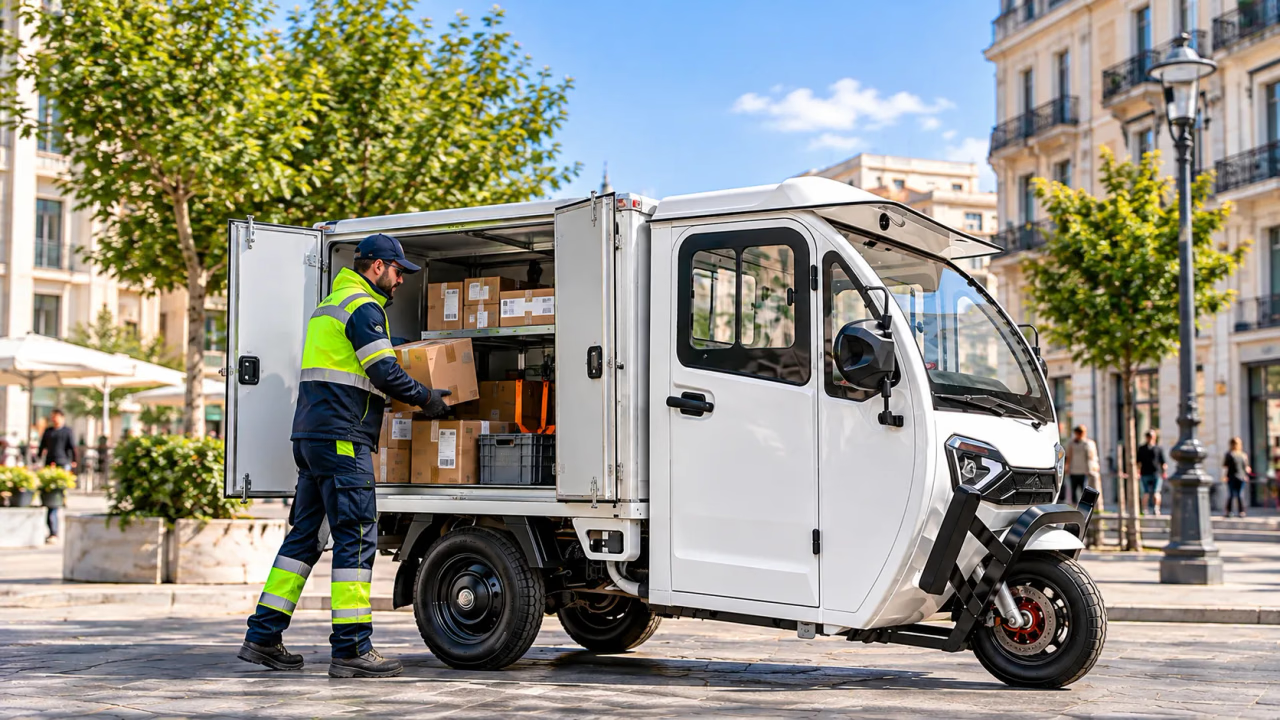
You do not always need a van to move tools, materials or small quantities of goods. For short trips in urban areas or large sites, an electric work tricycle can be the better option than an underused van when load and route suit the vehicle size.
The choice is not only about powertrain. Actual load, space needed, distance, stops and how the vehicle is used each shift all matter.
Read what an electric work tricycle is for context.

When an electric work tricycle can fit
A compact vehicle can make sense for frequent moves, moderate loads and repeated work in a limited area.
Examples include maintenance staff crossing a park, small urban jobs or short delivery routes.
Vehicle size and load configuration can matter as much as capacity. Compact size may help in tight workspaces—verify turning circle and dimensions on the specific model.
Before choosing, check:
- Routes: kilometres per shift and areas served.
- Stops: loading, unloading and interventions.
- Load: weight, size and type of materials.
- Access: passage width, parking and working space.
- Charging: outlet availability between shifts.
Urban logistics time is not only driving. Stops and last-metre handling matter, as highlighted in the ITF-OECD study on the final metres of urban delivery.
For city delivery services, see also electric tricycles for urban logistics.
When a van remains the better choice
A van generally offers more load space for bulky, heavy or high-volume goods.
Consider a van when you need:
- Higher load volume;
- Long or bulky items;
- Room for more equipment or custom interiors;
- Longer distances or inter-site transfers;
- Load protection aligned with the service.
Passenger count is decisive. Teams need a vehicle type-approved for the required seats—a tricycle is not an automatic van replacement.
Compare the job, not just the vehicle
| Aspect | Electric work tricycle | Small van |
|---|---|---|
| Load type | Goods compatible with bed/box and approved payload | Bulkier, heavier loads depending on version |
| Footprint | Usually smaller; check model dimensions | Usually larger; varies by version |
| Frequent work in a small area | Can suit short routes and close stops | May be oversized when load volume is not needed |
| Load protection | Depends on bed, box or closed compartment | Depends on body and fit-out |
| Carrying staff | Limited to approved seats | Versions with more seats available |
| Energy planning | Charging plan and real-world range on your cycle | Depends on powertrain and version |
A tricycle can complement the van
It need not be either-or. Both vehicles can play different roles.
A van may move kit between depot and site; a tricycle may handle short hops and lighter loads.
Plan distances, times, loads, space and access rules. Not for every business, but valid when part of the work does not need van capacity.
Which eCargo configuration to consider
Three eCargo setups differ by load area. See which electric work tricycle to choose for an overview.


eCargo Pickup : closed cab and tipping open bed—maintenance and materials with open-bed unloading where suitable.
eCargo Open : open station and high-sided box—when box access matters.
eCargo Box : closed goods compartment—for protected deliveries.
Check approved payload, dimensions, equipment, range and operating conditions.
Is a compact vehicle right for your activity?
Before replacing a van, log a typical day: kilometres, shift length, stops, load weight and size, people on board and idle time. Then check range, charging and type-approval rules.
For costs, compare total cost of use. See electric vs petrol and LPG and electric work tricycle pricing. Use real vehicle data for comparisons.
Method reference: ACI kilometre operating costs.
For full cost comparison and multi-vehicle replacement, see total cost of ownership and fleet electrification.

Assessment for your activity
Replacing or complementing a small van? Tell us what you carry and where you work.
Sources
Urban logistics and legal context—not eCargo performance certificates.
Considering an electric tricycle for your work?
Explore available configurations and find the one that fits your operations.
Related insights

Electric tricycles for urban deliveries: a last-mile option to assess
Last mile in the city: when a work tricycle fits, choosing the bed and planning stops and charging.
Read articlePayload and load volume: how to choose the right bed for your work
Useful payload vs space: criteria for open bed, high sides or box without mixing weight and volume.
Read article