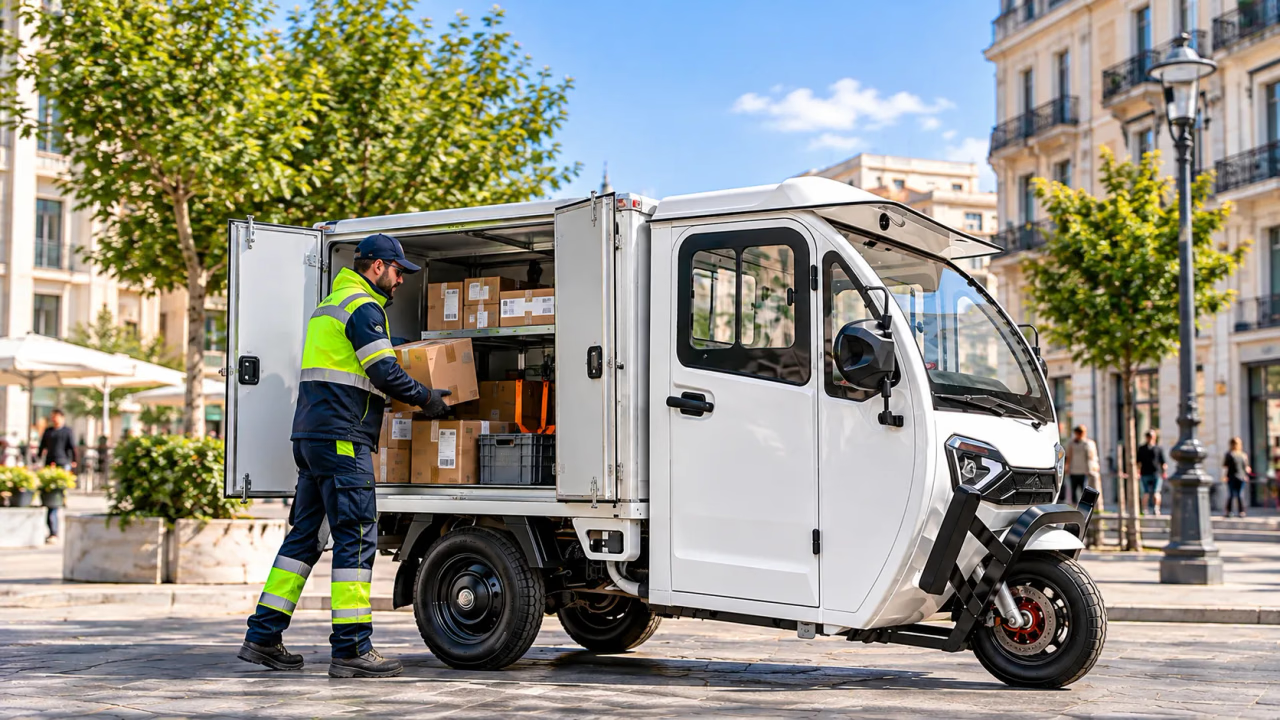
City deliveries differ from long-haul transport. They often involve heavy traffic, frequent stops and little room to load and unload. For some businesses, an electric work tricycle may be worth assessing—not to replace every van, but to handle short legs and deliveries that fit its size and rated payload.
To understand the vehicle category, read what an electric work tricycle is and how it works.

What last-mile delivery means
Last mile is the final leg from a distribution point to the recipient: parcels, shop replenishment, transfers between nearby sites or small orders to customers.
It requires organisation: relatively short distances but many stops, traffic and time spent loading, unloading and handing over. Vehicle choice should not rely on kilometres alone—parcel count, size, weight, stop frequency and space at recipients matter too.
When an electric tricycle may help with deliveries
A cargo electric tricycle may fit when deliveries suit a compact vehicle: manageable parcels, defined routes, short distances and frequent stops. For urban last mile, the best-matched electric tricycles are often those with a workable load area and frequent stops—not necessarily the highest payload rating. Uses include local distribution, shop runs, proximity delivery or internal moves on large sites.
It is especially relevant when part of your work is urban or stop management is critical. Compact size can ease some manoeuvres in tight spaces; the real benefit still depends on routes, local traffic rules and the specific vehicle.
Electric drive means no tailpipe emissions while moving and can reduce propulsion noise versus a combustion engine. Operational and economic outcomes still depend on consumption, charging, shifts, maintenance and how you use the vehicle.
For city delivery, see also urban logistics and related goods transport applications.
The load bed makes the difference
For deliveries you need to know how parcels are shaped, loaded and how often they are taken out during a shift—not just nominal space.
An open bed allows access from several sides; high-sided boxes contain loads; a closed box organises goods in a defined space. A box alone does not mean waterproof, insulated or refrigerated—confirm any such performance with the manufacturer’s documentation.

Useful volume is not the same as payload. Bulky light parcels or few heavy ones both need to stay within the rated payload, weight distribution and securing rules. See payload and load volume.
Which eCargo configuration to assess
The eCargo range has three layouts. Choice depends on goods and how you handle them on delivery rounds.
For a general comparison, see which electric work tricycle to choose.
eCargo Box: goods and deliveries
Cab plus closed cargo volume is the first configuration to assess when you need dedicated space for parcels and products—local distribution and proximity delivery, checking van dimensions and payload against your goods.
eCargo Box product pageeCargo Pickup: materials to move

Cab and open tilting bed can suit materials, containers or kit that must load and unload easily—not always the first choice for every parcel type; it depends on how you protect and organise goods.
eCargo Pickup product pageeCargo Open: accessible loads

Open station with high-sided box suits frequent access and varied shapes; for packaged goods you must plan protection and securing in transit.
eCargo Open product pageYou can also compare the three eCargo models on the product pages.
Organising delivery service with electric tricycles
Before adding a tricycle, sample a few representative shifts:
- average deliveries and stops per shift;
- kilometres and travel time;
- parcel weight, size and count;
- load/unload frequency;
- depot and charging availability;
- access, parking and circulation constraints on the route.

That shows which legs suit the tricycle and which stay with a van. Mixed fleets often work best—see electric tricycle or small van. The tricycle can cover part of local delivery; the van keeps longer legs, bulky or heavier loads.
Charging belongs in shift planning: actual charge times, energy needed and hours plugged in must be verified before sizing the fleet.
For LEZ access, plates and urban road rules, see licence, plate and type approval.
Urban delivery needs the right vehicle, not necessarily the largest
Bunder Mobility holds the most requested eCargo models in stock for prompt delivery — useful when you need to start or expand a fleet on tight deadlines and keep transport costs down.
An electric work tricycle can interest operators with frequent short-round deliveries and goods that fit the available bed. It does not automatically replace a van or guarantee access to LEZ, pedestrian areas or restricted streets—circulation depends on homologation category and local rules.
Bunder Company offers three eCargo layouts: open bed, high-sided box and closed volume. Start from goods, routes and daily delivery count to narrow the choice.

Organising city deliveries or assessing a more compact vehicle?
Tell Bunder about your goods, routes and indicative delivery count—we can suggest a configuration to review and the technical points to verify.
Considering an electric tricycle for your work?
Explore available configurations and find the one that fits your operations.
Related insights

Electric tricycle or small van? When a compact vehicle makes sense
When compact is enough, when a van stays necessary and how both can work together.
Read article
Payload and load volume: how to choose the right bed for your work
Useful payload vs space: criteria for open bed, high sides or box without mixing weight and volume.
Read article