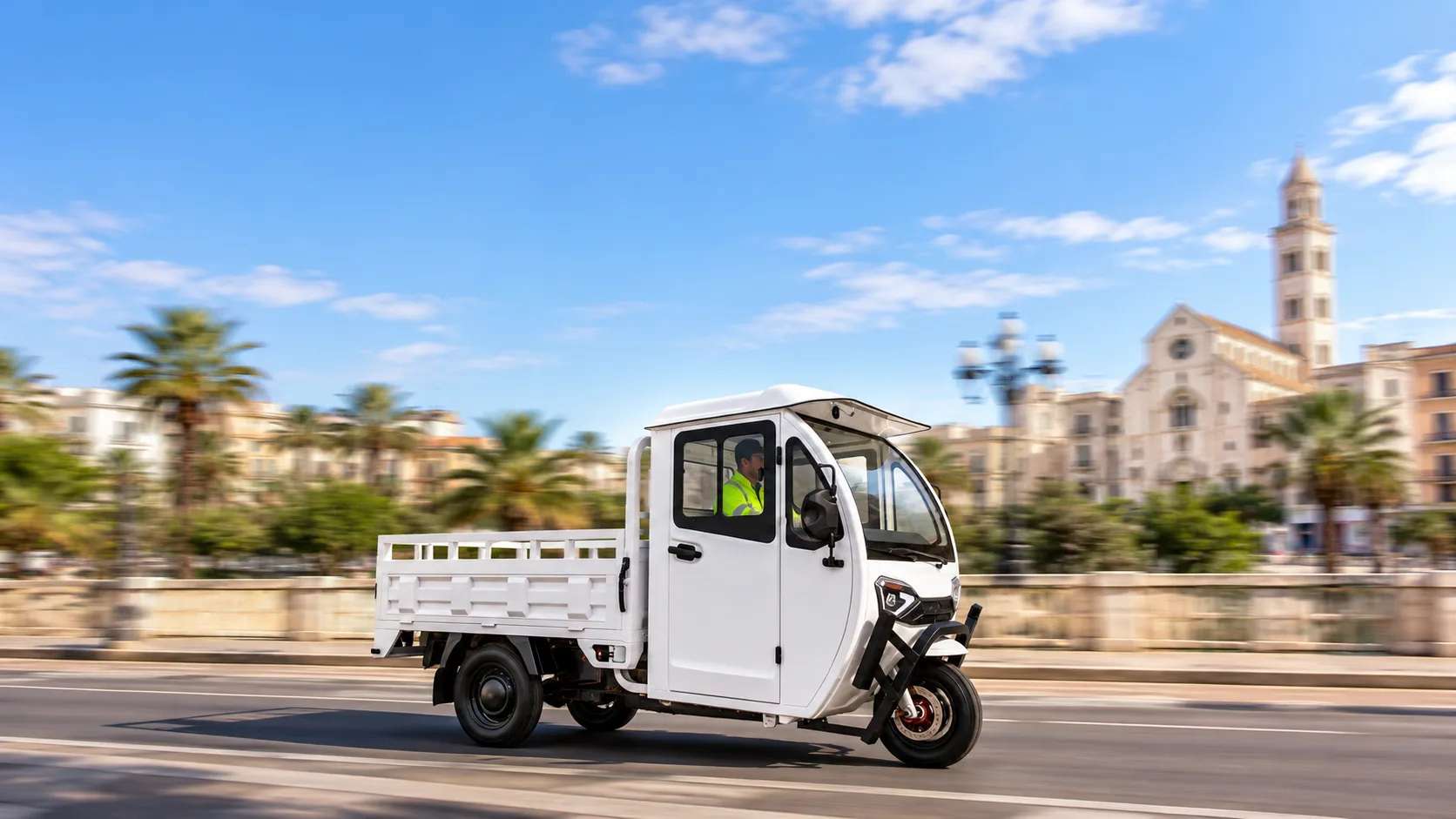
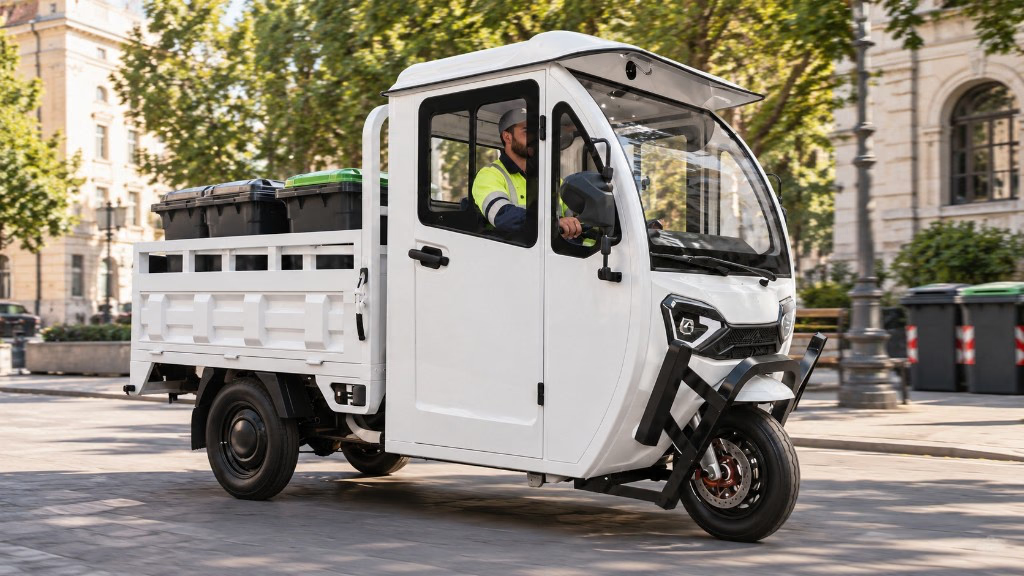
Before buying an electric work tricycle, check not only range, load capacity and bed configuration but also its classification for road use. That determines the documents required, the driving licence needed and the rules for using the vehicle on public roads. To frame the electric work tricycle category, see the dedicated article; here the focus is licence, plate and documents.
Three wheels and an electric motor do not define the vehicle category on their own. Two similar-looking vehicles can have different type-approval data and therefore different requirements.

Electric tricycle and type approval: why category matters
For two- and three-wheel vehicles intended for road use, the European reference is EU Regulation 168/2013. It distinguishes several categories, including L2e (three-wheel mopeds) and L5e (powered tricycles). Reference text: Regulation (EU) No 168/2013.
Category L2e covers three-wheel mopeds. Technical criteria include a maximum design speed not above 45 km/h and, for electric vehicles, a maximum continuous rated power up to 4 kW. Mass limits and other construction requirements also apply. Subcategory L2e-U covers three-wheel commercial vehicles designed to carry goods.
Category L5e identifies powered tricycles that are not within L2e. It includes, among others, subcategories L5e-A and L5e-B for commercial tricycles that meet specific construction and goods-transport requirements.
These are not marketing labels. They determine which technical and administrative rules apply. Before purchase, check the category and subcategory stated in the official documentation.
Illustrative diagram (not exhaustive): the actual category is read from the CoC
- Maximum design speed ≤ 45 km/h (regulation criteria)
- Electric: maximum continuous rated power 4 kW
- Subcategory L2e-U: goods use (where provided)
- Tricycles outside L2e limits
- Subcategories L5e-A and L5e-B (commercial, where applicable)
- Distinct construction and administrative requirements
For eCargo Pickup, eCargo Open and eCargo Box we do not state an L2e or L5e category in this article: we do not hold the certificate of conformity for versions sold in Italy in this repository. Before ordering, ask the supplier for the CoC and documents for the configuration offered.
Which licence is needed to drive an electric tricycle?
The licence depends on the type-approval category and the technical parameters recognised for the vehicle. In Italy, article 116 of the Highway Code (Codice della Strada) sets entitlements for each category:
- AM: entitles the holder to drive category L2e vehicles that meet the requirements, including maximum design speed up to 45 km/h and maximum continuous rated electric motor power not above 4 kW.
- A1: entitles the holder to drive tricycles with power not above 15 kW.
- A: required for tricycles with power above 15 kW, subject to age requirements in the Highway Code.
Category B includes certain equivalences under Italian law: it also covers category A1 vehicles and, in Italy, from age 21 allows driving tricycles above 15 kW nationally. Conditions must be read together with the vehicle’s actual category and any restrictions on the licence. A commercial figure such as maximum motor power is not enough to determine the required licence: peak power is not necessarily the continuous rated power used for classification. The correct reference is in the type-approval documents. Article 116 Highway Code — licence categories; equivalences: 125 Highway Code. ACI — category A licence.
Plate, registration and required documents
Administrative obligations vary by vehicle category.
For mopeds, article 97 of the Highway Code provides for a circulation certificate and a plate linked to the registered keeper. For motorcycles, article 93 covers registration and the circulation document; article 100 requires a rear plate.
When buying, ask the seller which documents will be supplied and which formalities apply to that version. Documentation must clearly identify the vehicle, its category, the frame number and approved technical data.
For new vehicles type-approved under EU rules, the certificate of conformity (CoC) is central to registration. Before ordering, confirm that the manufacturer or supplier can provide the documentation required for the version you buy.
Mopeds: art. 97 Highway Code; motorcycles: art. 93 Highway Code, art. 100 Highway Code (plate). For payload and approved technical data see also payload and load volume.
Insurance and periodic inspection
When the vehicle is subject to road circulation rules, check third-party liability insurance. Article 193 of the Highway Code prohibits circulation without mandatory insurance.
Mandatory third-party cover: art. 193 Highway Code.
Periodic inspection
Periodic inspection should be part of fleet management. Italy’s Ministry of Infrastructure and Transport indicates, for mopeds and motorcycles, the first inspection four years after first registration and every two years thereafter. The actual due date must be checked on the vehicle documents and rules for its category.
Companies running several tricycles should track this routinely: up-to-date documents, valid insurance and recorded deadlines for each vehicle.
Indicative deadlines: MIT — periodic vehicle inspection.
Can electric tricycles enter low-emission zones (ZTL)?
Article 7, paragraph 9-bis of the Highway Code requires municipalities to allow free access to limited traffic zones (zone a traffico limitato, ZTL) for electric or hybrid vehicles. That matters for electric vehicles used for urban services and deliveries.
Before planning a service, check municipal procedures: plate or permit registration, portal enrolment, gate management and required documents. Distinguish ZTLs from pedestrian areas, bus lanes and other restrictions with their own rules.
ZTL access is not a general authorisation to drive anywhere in the city or on any route. Vehicle category, Highway Code rules and signage limits still apply.
Reference: art. 7 Highway Code (ZTL and electric/hybrid propulsion).
What to verify before buying an electric work tricycle
Before choosing a model, ask the supplier to confirm in writing:
- Type-approval category and subcategory of the version offered.
- European certificate of conformity or other applicable approval title.
- Power relevant for type approval and maximum design speed.
- Type of circulation document and plate expected.
- Licence required for driving in Italy.
- Insurance requirements and inspection deadlines.
- Any use restrictions and documents to keep on board.
If the vehicle only operates in private areas or large sites, public-road circulation is a separate issue: still verify category and documents if routes include roads open to traffic.
Assess model and documentation before purchase
Choosing an electric work tricycle should start from the job, then continue with configuration and the documents needed to use it. Open bed, high-sided box and closed box meet different needs; similarly, apparently similar versions can have different type-approval classifications.
Bunder can help identify the eCargo configuration that fits the work and check documentation available for the version offered. For a useful assessment, state activity type, operating context and whether the vehicle will use public roads or only private areas. Bunder is not a substitute for legal counsel, a registration agency or an approval authority.
To compare Pickup, Open and Box see which electric work tricycle to choose.
For public tenders with CAM and technical equivalence, see electric tricycles in public procurement and specifications.


Regulatory and institutional sources
Information verified on 2 November 2026. For specific cases, the type-approval document and circulation papers for the individual vehicle prevail, together with law in force at the time of use.
Frequently asked questions
Request information on model and documentation
Contact us about eCargo configuration and type-approval documents available for the version offered. The form can be pre-filled for documentation requests.
Considering an electric tricycle for your work?
Explore available configurations and find the one that fits your operations.
Related insights

What is an electric work tricycle and how does it work?
Definition, components, load configurations and criteria to explore the eCargo range.
Read article
Electric tricycles in public services: how to evaluate them and write technical specifications
Service, homologation, CAM 2021 vs 2025 and equivalence—no undocumented L category on eCargo.
Read article