When a business evaluates a new work vehicle, purchase price is only part of the investment. To see whether an electric tricycle truly pays off you need what it costs over years of service.
This approach is called TCO, Total Cost of Ownership—the full cost of running the asset. It is especially useful when comparing electric with petrol or LPG, or when deciding whether to replace part of a fleet.
Comparison must start from the work the vehicles will do. Two units can have very different purchase prices, but that only matters when assessed over the same period for equivalent activity. For a fuel comparison see electric tricycle vs petrol and LPG; for electric work tricycle purchase price see the dedicated article. Here the focus is full cost over time.

What TCO includes for an electric tricycle
TCO covers spend from purchase through the end of the period you choose. For an electric work tricycle, the main line items are:
- Purchase and commissioning: vehicle price, transport, optional bodies and accessories, preparation, and direct start-up costs tied to supply.
- Energy: electricity for charging, at the effective cost borne by the company—not a generic domestic tariff.
- Maintenance and repairs: scheduled checks, interventions, parts, tyres, brakes, and wear components.
- Battery: possible replacement or work expected in the period, per conditions and warranty of the chosen configuration.
- Administration and operation: insurance, taxes, inspections if applicable, and other charges for the vehicle category.
- Charging and infrastructure: chargers, outlets or bays, electrical upgrades, and the share of investment attributed to the vehicles.
- Operational downtime: costs or economic impact when the vehicle is unavailable, when they can be estimated reliably.
Categories to include in total cost of ownership
At period end: − residual value − confirmed incentives (if applicable)
At period end, include any residual value. Confirmed incentives actually granted to the company for that category can be entered separately. Not every line applies equally: a depot already served with power may need a different investment than a site upgrading the installation.
How to calculate total cost of ownership
For a first comparison you can use a simple formula:
TCO = purchase and start-up + operating and maintenance + charging investment attributed to the vehicle − residual value − confirmed incentives.
Operating cost must include all spend in the chosen period. If you use full purchase price, do not also amortize the same investment twice. Alternatively use a depreciation and cost-of-capital model, consistently for every vehicle compared.
To make the result readable, TCO can be related to use:
- Cost per kilometre: period TCO divided by kilometres in the same period.
- Cost per work hour: TCO divided by effective hours of use.
- Cost per shift or service: useful when the vehicle runs recurring duties where mileage alone does not describe the job.
For a fleet, calculate both total cost and average cost per vehicle. That highlights under-used units, differences between shifts, and configurations that fit assigned work better.
Electric vs fuel comparison must be the same work
Comparing one recharge with one tank fill is not enough. Estimate how much work that energy delivers and include other costs affecting the vehicle.
For electric, record grid kWh used for charging and apply the company's effective energy cost. The most useful figure comes from metering at the outlet or charge point, because it includes charging losses. Read the bill for your business contract and applicable variable components. ARERA.
For petrol or LPG, use actual consumption on work routes and the price paid for fuel. Published national averages can be a general reference but do not replace invoices and your own refuelling data.
Compare maintenance from records and invoices, not from the assumption that electric needs no service. Brakes, tyres, suspension, chassis, and load bed still need checks. Battery cost depends on technology, use, and manufacturer guidance.
For electric energy cost see electric tricycle recharge cost and For maintenance and battery: electric tricycle maintenance, LiFePO4 or lead battery. Fuel context: electric, petrol and LPG comparison. Average fuel reference (does not replace invoices): MIMIT — national average prices.

Which data to collect before deciding
A credible comparison does not require a complex financial model first. It is more useful to collect real data for a representative work period.
| Data to capture | Why it matters |
|---|---|
| Purchase price and start-up costs | Defines initial investment |
| Kilometres and hours of use | Relates cost to work performed |
| Actual fuel or kWh consumption | Calculates energy cost |
| Maintenance and repair spend | Measures technical cost over time |
| Insurance, taxes and other charges | Completes operating cost |
| Expected life and residual value | Sets comparison horizon |
| Chargers and installation cost | Includes required infrastructure |
| Downtime and substitute vehicles | Helps estimate impact on operations |
Data must refer to vehicles doing comparable work: routes, loads, hours, stops, and shifts should be as similar as possible. If the electric unit is assigned different work from the thermal vehicle, the economic comparison loses meaning.
When switching to electric may pay off
An electric tricycle can make sense when work fits available range, loads stay within permitted limits, and the vehicle can recharge regularly at base or during planned breaks.
Activities with repeated routes, frequent moves, and depot returns are often easier to plan. Then the company can meter energy, schedule charging, and verify availability for the next shift.
More caution is needed for long routes, steep gradients, heavy loads, back-to-back shifts, or lack of adequate charging. Check range, charge times, route fit, and need for support vehicles first.
You do not need to replace the whole fleet at once. Many organizations identify one compatible service, introduce one or more vehicles, and record consumption, time, maintenance, and availability for a representative period before expanding.
Check range and shift with electric work tricycle range. Shifts and charging: fleet shifts and charging. Depot power: fleet charging power sizing.
Which eCargo configuration to assess
Model choice affects how the vehicle is used and therefore its full cost.
eCargo Pickup — eCargo Pickup has a closed cab and open bed, for work that needs material transport and an accessible load area. Product page
eCargo Open — eCargo Open has an open driving position and high-sided box—worth assessing for frequent handling when load-bed access is a priority. Product page
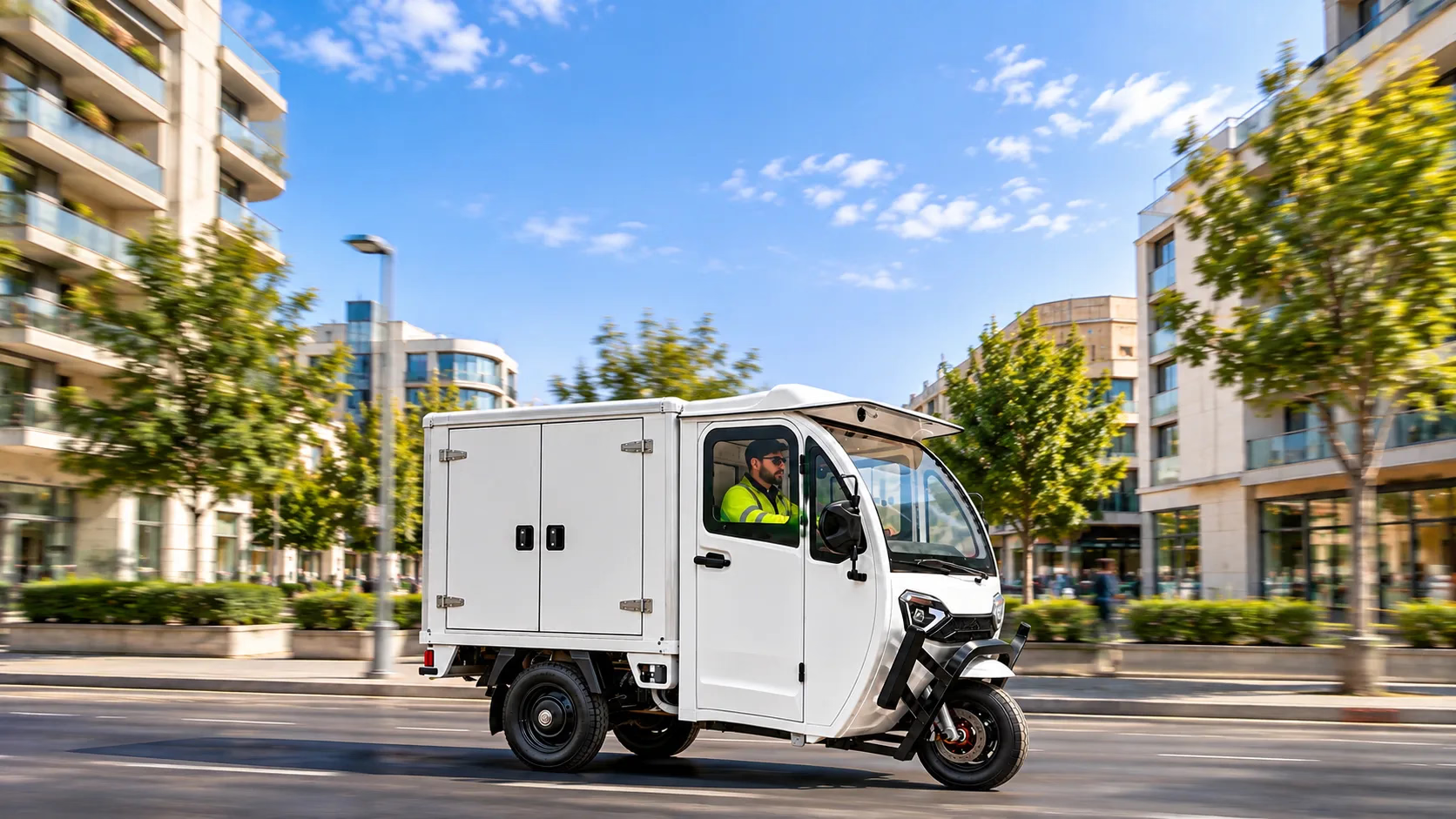
eCargo Box — eCargo Box has a closed cab and enclosed cargo volume when separating and protecting carried goods matters. Product page


The right model is not chosen on price alone. Verify load, dimensions, route, required range, available battery, approval category, and conditions of use. Payload and other specs must be confirmed on official documentation for the proposed configuration.
If you are replacing several vehicles or tracking them in service, link TCO to fleet electrification and GPS and fleet management.
Assess TCO before buying
Total cost of ownership compares alternatives with criteria closer to real company use. A useful result starts from usage data, includes relevant line items, and compares vehicles over the same time horizon.
At Bunder we can help identify the eCargo configuration to explore from activity type, routes, loads, and shift organization. For an initial assessment it helps to know how many vehicles you need, how much they work each day, and where they can charge.
FAQ on total cost of ownership
Request information for your TCO assessment
Describe your activity and fleet needs: we can assess together the model and configuration that fit best. Share fleet size, daily use, and charging: we help identify the eCargo configuration and data to collect for a sound economic comparison.
Considering an electric tricycle for your work?
Explore available configurations and find the one that fits your operations.
Related insights

How much does an electric work tricycle cost? Price, configurations and costs to consider
What drives the quote, what to check in an offer and which details to prepare for an accurate request.
Read article
Electric tricycle, petrol or LPG: which makes sense for work?
Electric vs petrol and LPG on costs, maintenance, shifts and moving to the eCargo range.
Read article