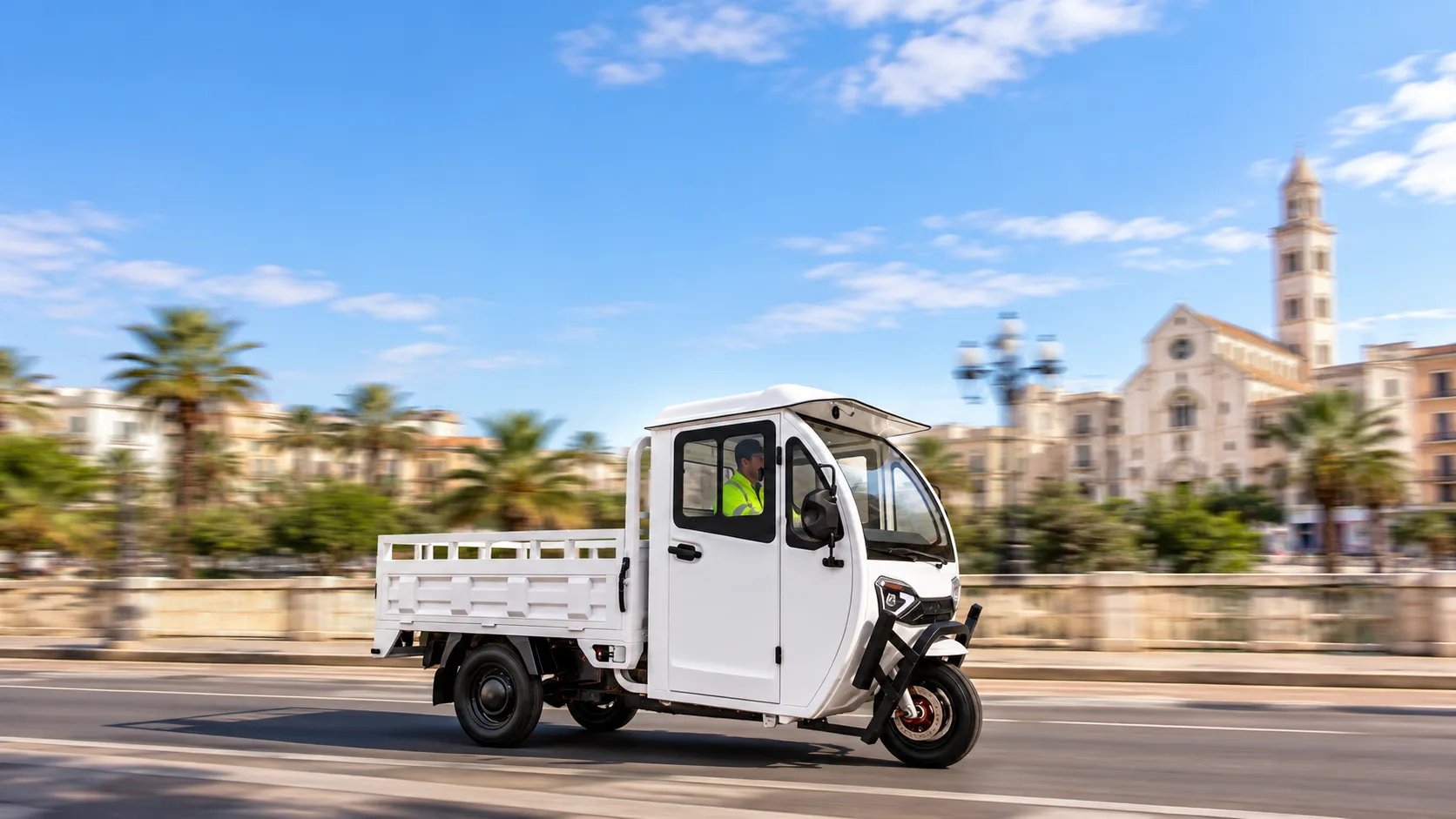
When choosing a work tricycle, powertrain type affects costs, maintenance and daily organisation. Electric can suit predictable distances, daily returns to base and charging during stops. Petrol and LPG may be more practical when you need quick refuelling or work far from a charging point.
No powertrain is best in absolute terms. The choice depends on how the vehicle is used, kilometres driven, payload and time between shifts. Comparing electric with petrol or LPG only makes sense after describing the real service.

Compare the job first, not the engine
A tricycle used for short trips, many stops and urban work has different needs from one that covers long distances without returning to depot. Before comparing electric, petrol and LPG, describe a typical day.
A few data points matter:
- kilometres per shift and per week;
- shift length and number of stops;
- weight and volume of materials carried;
- gradients, road surface and restart frequency;
- where the vehicle can be refuelled or charged;
- time available for refuelling or charging.
Electric fits well when routes and hours are predictable. If the vehicle returns to the same base daily, charging can be built into the shift. If distances vary and stops are too short, access to fuel stations can favour petrol or LPG.
Running costs: comparing electricity, petrol and LPG
Cost per kilometre is useful only with measured consumption and prices your company actually pays.
For electric vehicles, start from energy drawn from the grid when charging, measured or taken from charging system documentation including charger losses.
Energy cost per 100 km
kWh drawn per 100 km × actual business cost per kWh
For petrol or LPG, use consumption measured in litres per 100 km.
Fuel cost per 100 km
litres consumed per 100 km × actual price per litre
LPG may cost less per litre than petrol, but you cannot compare pump prices alone. Consumption and energy content differ. Use the vehicle's measured consumption in real work.
Electricity price must reflect business supply, bill components and time-of-use if relevant. A domestic tariff from an online example can mislead.
Compare on the same route with similar loads. Manufacturer figures are a starting point; fleets should measure during a trial period.
For a structured comparison you can use the electric convenience tool.
| Electric | Petrol | LPG | |
|---|---|---|---|
| Energy / refuelling | Grid energy, depot charging, time-of-use to check | Litres per 100 km, actual pump price | Litres per 100 km, measured consumption |
| Maintenance | Manufacturer plan for traction, brakes, battery | Combustion engine and auxiliaries | Engine + LPG system checks |
| Shift planning | Scheduled charging between shifts | Quick refuel, variable routes | Like petrol, check LPG availability |
| Points to verify | Real-world range, charging infrastructure | Measured consumption, business fuel cost | Consumption vs litre price, vehicle approval |
Maintenance: what to expect
A battery-electric vehicle has no internal combustion engine, so some petrol or LPG routines such as engine oil and exhaust-related work on the thermal version may not apply.
Electric still needs maintenance: brakes, tyres, suspension, frame, electrical connections and traction components per the manufacturer plan. Battery care—charging mode, temperature, storage and use—affects life.
Petrol vehicles follow engine and auxiliary schedules. LPG adds gas-system checks per manufacturer and applicable rules.
Compare concrete maintenance programmes, not theoretical technology lists. Track hours, parts, downtime and cost per vehicle annually.
Noise and emissions in service
Electric vehicles produce no tailpipe emissions in use and are usually quieter and smoother than combustion vehicles—relevant in busy areas, sensitive hours or noise-sensitive work.
Tailpipe emissions differ from full lifecycle impact. Electricity generation, battery and vehicle manufacturing also have impacts. Full lifecycle analysis needs specific data and the power mix.
When to choose electric and when to consider petrol or LPG
Electric deserves attention when:
- daily routes are fairly regular and match available range;
- the vehicle returns to a base where it can charge;
- stops and restarts are frequent;
- lower noise and tailpipe emissions help the service;
- the company wants to control energy use and schedule charging.
Petrol or LPG may fit when the vehicle must stay operational long without returning to charge, distances are hard to predict or stops cannot cover charging time. Still check fuel availability, maintenance and real costs.
Some companies transition gradually: start with services that suit electric, measure results, then decide whether to extend.
Total cost matters more than purchase price alone
To see if electric truly pays off, compare full cost over the years of use. Purchase price is only one line item.
In a business assessment, consider:
- vehicle and body purchase;
- electricity or petrol/LPG;
- routine maintenance and repairs;
- battery replacement when needed;
- insurance and other recurring costs;
- charging infrastructure and electrical upgrades;
- downtime and replacement vehicle availability;
- residual value at end of period.
The method is the same for all powertrains: set an analysis period, use comparable assumptions and documented costs. Annual mileage and utilisation intensity can change the outcome significantly.
For grid energy costs and a full operating-cost checklist, see electric tricycle charging costs and total cost of ownership.
Want a comparison for your service?
Share mileage, payload and depot charging options—we can help assess electric fit for your shift.
How to assess switching to an electric tricycle
The useful question is not only how much an electric tricycle consumes, but whether it fits the service. Open bed, high-sided box and closed box answer different needs. Payload, dimensions, range and road use must be checked on the proposed configuration documentation.
Before comparing powertrains, clarify how an electric work tricycle works.
The eCargo range distributed by Bunder Company includes three configurations to assess for your work: eCargo Pickup, with cab and tipping open bed; eCargo Open, with open station and sided box; eCargo Box, with cab and closed cargo box.
Replacing petrol or LPG can start simply: describe route, payload, shifts and charging location. That shows whether electric fits and which configuration to explore.
Let's assess which powertrain fits your work
Bunder Company can help identify the tricycle to explore based on intended use and how your operation is organised.
If you are moving from petrol or LPG, share kilometres driven, what you carry and where charging could happen. That enables a concrete comparison without generic savings claims.

Considering a move from petrol or LPG?
Talk to Bunder and request an assessment for your activity
Sources and comparison criteria
Institutional references on efficiency, emissions, prices and operating costs. They do not replace documentation for the eCargo configuration you plan to buy.
Considering an electric tricycle for your work?
Explore available configurations and find the one that fits your operations.
Related insights

Is switching to electric tricycles worth it? How to calculate total cost of ownership
Purchase, energy, maintenance, charging, residual value—TCO method without invented savings.
Read articleHow much does it cost to charge an electric tricycle? Shift and recharge cost calculation
Grid kWh and your variable business rate—estimate recharge and shift cost without nominal-capacity traps.
Read article
What is an electric work tricycle and how does it work?
Definition, components, load configurations and criteria to explore the eCargo range.
Read article