
When transporting materials, equipment and supplies in urban settings, an electric cargo bike and a professional electric tricycle can look like similar solutions. Both are relatively compact, use electric propulsion and move loads without a traditional commercial vehicle.
The differences, however, are substantial.
A pedal-assist cargo bike is designed to combine transport with cycling mobility: the rider pedals while the motor provides assistance within regulatory limits. A professional electric tricycle such as eCargo is instead a motor vehicle built for operational handling, with a declared nominal payload between 500 and 1,000 kg, a stated maximum speed between 40 and 42 km/h and, in the relevant configurations, a driving cab.
The right choice therefore depends on the type of work, the weight of materials to carry, route characteristics and the conditions in which the operator must work.
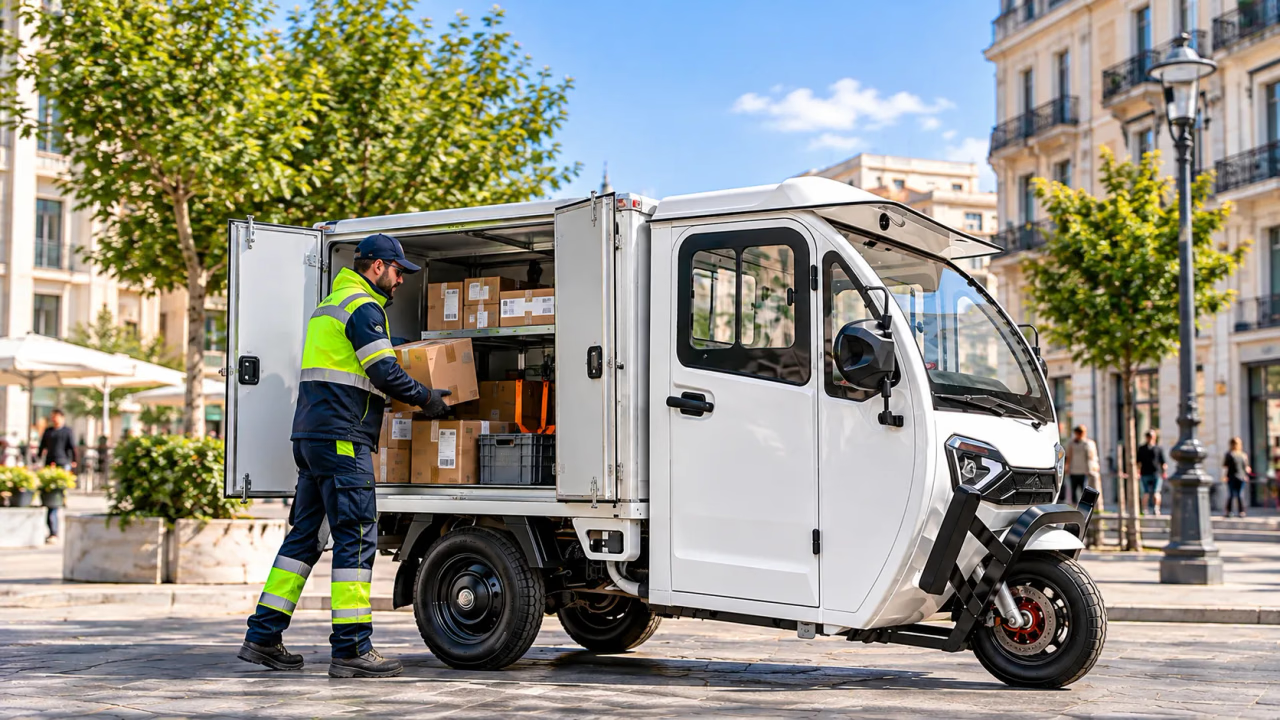
Cargo bike and electric tricycle: what is the difference?
The first distinction concerns the propulsion system and, consequently, the vehicle's regulatory category.
An electric cargo bike is a bicycle designed to carry goods or equipment, fitted with an auxiliary motor that assists pedalling effort. It can have two or three wheels and different load-bed configurations.
A professional electric tricycle is instead a motor vehicle intended for operational transport. It does not require the rider to pedal and can be designed with a flatbed, open box or enclosed load area.
Wheel count alone is therefore not enough to tell the two categories apart: there are also three-wheeled cargo trikes that remain pedal-assist bicycles.
Regulatory differences
In Italy, Article 50 of the Highway Code governs cycles, including pedal-assist bicycles.
To qualify as a cycle, a pedal-assist bicycle must meet specific technical conditions. The maximum continuous rated power of the auxiliary motor is generally 250 W, raised to 500 W for cycles intended for goods transport. In both cases, assistance must be progressively reduced and cut off at 25 km/h or when the rider stops pedalling.
This limit applies to the speed at which the motor stops assisting, not the maximum speed physically reachable by pedalling alone.
The eCargo electric tricycles marketed by Bunder Company belong instead to type-approval category L2e, provided for in European Regulation 168/2013 for three-wheeled mopeds.
Category L2e provides for a maximum design speed of 45 km/h and a maximum continuous or net rated power of 4 kW, along with the other technical and mass requirements set out in the regulation.
The eCargo range shows declared maximum speeds of 40 or 42 km/h, consistent with the speed limit for this category.
This distinction also matters for traffic: an L2e type-approved vehicle must not be treated as an e-bike and cannot assume access to the same cycle infrastructure. Refer to the rules of the approval category and the provisions applicable to each route.
Regulatory references: Highway Code, Article 50 – ACI · European Regulation 168/2013 – EUR-Lex
Load capacity: how much can a cargo bike carry?
Payload is one of the most relevant differences when the vehicle must be used throughout a work shift.
Professional cargo bikes come in different configurations, but even on models designed for heavier loads you must distinguish between maximum box weight, maximum permitted gross vehicle weight and the weight actually transportable once rider, accessories and fittings are accounted for.
To understand the differences better, some models on the market can be used as reference points.
Comparing load capacities
The difference concerns not only weight but also the type of material transported.
Cargo bikes are particularly effective for parcels, small supplies, urban deliveries and compact equipment.
Professional tricycles instead make it possible to organise transport of operational equipment, bulky materials, tools and supplies used during maintenance work and field services.
For an urban cleaning company, for example, moving bags, tools and service materials may require load space and capacity beyond what is normally available on a cargo bike.
The same applies to green-space maintenance, public-area management and technical work that requires carrying several pieces of equipment at once.
| Model | Type | Declared load limit |
|---|---|---|
| Urban Arrow Cargo L/XL | Professional cargo bike | 125 kg on the front box; 250 kg maximum overall weight, including bike, box, rider and load |
| Winther CX | Electric three-wheeled cargo bike | 100 kg in the box; 250 kg maximum overall weight |
Sources: Urban Arrow and Winther CX (check the manufacturer's website). Figures refer to specific models and do not represent universal limits for all cargo bikes.
These figures refer to specific models and do not represent universal limits for all cargo bikes.
The eCargo range is designed for different handling needs. Published spec sheets report a nominal load capacity of 500 kg for eCargo Open and 1,000 kg for eCargo Pickup and eCargo Box.
That is a declared capacity significantly higher than the professional cargo bike models used as reference, and it makes it possible to consider work that requires moving heavier materials and equipment.
Technical note: the nominal payload shown on product sheets must not automatically be read as load that is always admissible. Usable load must comply with the maximum technically permitted mass, type-approval documentation, weight distribution and the manufacturer's requirements for the individual vehicle.
Speed and productivity: 25 km/h versus 40–42 km/h
Another difference concerns operating speed.
A pedal-assist cargo bike must cut electric assistance at 25 km/h. The rider can of course keep pedalling and reach higher speeds, but without motor support.
eCargo electric tricycles, as L2e type-approved vehicles, show the following declared maximum speeds:
The difference can affect how a professional service is organised, especially when the vehicle makes many trips during the day.
Productivity is not about top speed alone. Loading and unloading times, distance between jobs, material carried and planned stops also matter.
A vehicle that carries more material in a single trip can cut the number of transfers needed and help organise work more efficiently.
Actual permitted speed always depends on road characteristics, signage and applicable traffic rules.
- 40 km/h for eCargo Pickup.
- 42 km/h for eCargo Open.
- 40 km/h for eCargo Box.
Cab and operator protection: an advantage for everyday work
Driver protection is particularly important in professional activities.
Traditional cargo bikes generally leave the operator exposed to the weather. Even configurations with covers or protective accessories do not necessarily offer the same level of protection as a closed cab.
eCargo Pickup has a cab with doors and opening windows, a windscreen wiper and an integrated fan.
The cab makes the vehicle especially relevant for operators who make repeated trips throughout the whole work shift.
It is important to note that the Pickup cab has no heating or windscreen defrosting. It is therefore a closed driving position protected from direct exposure to the weather, not a climate-controlled cabin.
eCargo Box also has a cab and enclosed load area, while eCargo Open favours an open layout with high-sided box.
- Seat with cushion.
- Seat belt.
- USB socket.
- Digital dashboard.
- Phone holder.
- Rear camera.
- Manual parking brake.
Use in winter and in the rain
The ability to use a vehicle year-round is important for companies running continuous services.
The Pickup's cab configuration offers greater protection than a typical cargo bike, especially when travelling in rain and on cold days.
According to operational guidance from Bunder, eCargo models can also be used in rain and at low temperatures, without particularly relevant perceived changes under normal operating conditions.
However, no published instrumented tests are available to quantify possible range variation at temperatures between 0 and 5 °C. Declared mileage figures should therefore be treated as indicative and not as a guarantee of range in every condition.
When planning a winter shift, consider route length, carried load, frequent stops, temperature and charging availability.
A closed cab must not be confused with thermal protection: without heating and defrosting, comfort and visibility must be assessed against actual operating conditions.
Three wheels and stability: which configuration suits work best?
Cargo bikes can be built with two or three wheels. Configuration affects vehicle behaviour, load distribution and how the machine is used.
A two-wheeled cargo bike handles similarly to a traditional bicycle: the rider must manage balance, including when starting and stopping.
A three-wheeled tricycle instead provides a support base that lets the vehicle stand upright on its own when stationary. That can help in work characterised by frequent stops and material handling.
In professional contexts it also matters whether the operator can get on and off often, load and unload, and carry equipment that does not fit easily on a conventional bicycle.
Three wheels do not automatically mean greater stability in every dynamic situation. Cornering behaviour, especially with heavy or unevenly distributed loads, depends on vehicle geometry, centre of gravity height, roadway and speed.
For that reason, the choice should be backed by a proper load assessment and use according to the manufacturer's instructions.
The eCargo range: three configurations for different professional needs
The eCargo range comprises three models designed to meet different transport needs.
The choice should not rely solely on nominal capacity, but also on load-bed configuration, material types and the operations to be carried out.


eCargo Pickup
eCargo Pickup is the configuration designed for activities that need a protected driving position and an easily accessible flatbed.
The spec sheet reports a nominal load capacity of 1,000 kg, a maximum speed of 40 km/h and a declared range of 70–80 km in the base configuration.
The flatbed measures 1,500 × 1,100 × 330 mm and is tipping, which helps when handling and unloading materials.
It is particularly suited to:
- Urban cleaning and micro-collection.
- Municipal services.
- Green-space maintenance.
- Transport of tools and equipment.
- Operational field interventions.
eCargo Open
eCargo Open prioritises practical handling through an open box with high sides.
The declared nominal load capacity is 500 kg, with a maximum speed of 42 km/h and an indicative range of 80–90 km in the base configuration.
The box measures 1,500 × 1,100 × 490 mm and gives direct access to carried materials.
This configuration is especially useful when materials, tools and supplies need to be loaded and unloaded frequently.
Applications include:
- Green-space maintenance.
- Urban cleaning.
- Agriculture and livestock farming.
- Technical and plant maintenance.
- Logistics and in-site handling.
eCargo Box
eCargo Box is designed for activities that require an enclosed transport area.
The spec sheet reports a nominal load capacity of 1,000 kg, a maximum speed of 40 km/h and a declared range of 70–80 km in the base configuration.
The cargo volume measures 1,500 × 1,100 × 930 mm and keeps goods separate from the outside environment while travelling.
It is a particularly interesting configuration for:
- Urban logistics.
- Last-mile deliveries.
- Commercial distribution.
- Supply transport.
- In-house maintenance.
- Technical and operational services.
Technical characteristics compared
| Characteristic | eCargo Pickup | eCargo Open | eCargo Box |
|---|---|---|---|
| Dimensions (mm) | 2.955 × 1.180 × 1.720 | 2.985 × 1.180 × 1.360 | 2.955 × 1.180 × 1.720 |
| Load bed (mm) | 1.500 × 1.100 × 330 | 1.500 × 1.100 × 490 | 1.500 × 1.100 × 930 |
| Nominal payload | 1.000 kg | 500 kg | 1.000 kg |
| Declared power | 2.200 W | 2.000 W | 2.200 W |
| Maximum speed | 40 km/h | 42 km/h | 40 km/h |
| Declared range | 70–80 km | 80–90 km | 70–80 km |
| Configuration | Cab and tipping flatbed | Open box | Cab and enclosed cargo area |
Figures are taken from published technical sheets for each model. Higher-capacity battery configurations are available, with longer stated range on those sheets. Real-world distance depends on use conditions, load, route and driving style.
For configuration details, see the technical comparison of the three eCargo models.
Running costs and environmental impact
Electric propulsion is a further point of difference from traditional vehicles and makes it possible to assess a different service management model.
While driving, electric tricycles produce no exhaust emissions. The absence of a combustion engine also helps reduce noise compared with equivalent thermal vehicles.
Economically, electricity can cost less than fuel for certain mileages and usage patterns. Actual savings must however be calculated taking into account purchase price, energy tariffs, shift duration, batteries and maintenance.
An electric vehicle is not maintenance-free. Tyres, braking, suspension, electrical components and the battery require checks and work according to the manufacturer's instructions.
For a company using several vehicles, a sound assessment should consider total cost of operation over the full period of use, rather than initial price or the cost of a single charge alone.
Environmental impact must also be assessed correctly: zero exhaust emissions in use does not mean zero environmental impact over the vehicle's full life cycle, which includes production, batteries, energy used and end of life.
When to choose a cargo bike and when a professional electric tricycle
The two solutions meet different needs. There is no universally better vehicle: there is the one that best fits the work to be done.
When an electric cargo bike makes sense
A cargo bike may be the most appropriate solution when:
- Loads are relatively light.
- Travel is mainly urban and over short distances.
- It is important to keep a pedal-based transport mode.
- Usable cycle infrastructure is part of the route.
- A protective cab is not required.
- Operations do not require continuously carrying particularly heavy equipment.
It is a particularly suitable solution for light urban deliveries, proximity services and distribution of small quantities of goods.
When a professional electric work tricycle makes sense
A professional electric tricycle such as eCargo becomes more interesting when:
- The service requires carrying heavier loads.
- Bulky materials and equipment need to be moved.
- Operations involve many stops and frequent loading and unloading.
- A tipping flatbed or enclosed cargo area is useful.
- The operator must use a motor vehicle without relying on pedalling.
- You want to organise a fleet of electric vehicles dedicated to operational activities.
The eCargo range is especially relevant for urban hygiene companies, municipal authorities and environmental operators, but also for businesses in green maintenance, in-house logistics and technical services.
Category L2e must still be factored into route planning and checks on traffic conditions.
How to identify the vehicle best suited to your activity
The choice should start from analysis of the service, not from isolated comparison of commercial specs.
Before choosing a vehicle, define:
This information helps assess not only which vehicle has the highest figures, but which configuration truly fits the activity.
For micro-collection, for example, a cab and tipper flatbed may matter more than a closed box. For maintenance work, an open load area can make tools and materials easier to reach. For deliveries, protecting goods may make a closed configuration preferable.
The right choice links technical characteristics, operational needs and running costs.
- Load type: materials, equipment, bags, parcels or supplies.
- Actual weight: average load, maximum load and transport frequency.
- Required volume: dimensions and organisation of the load area.
- Operational route: distances, gradients, surface type and traffic conditions.
- Service duration: daily kilometres, number of shifts and stop frequency.
- Working conditions: exposure to weather, operator protection and need for a closed cargo area.
- Charging: ability to recharge during stops or at the company depot.
Bunder Company: professional electric tricycles for work
Bunder Company distributes professional electric tricycles in Italy and supports companies, public authorities, environmental operators and field teams in choosing solutions suited to their activities.
The eCargo range comprises three different configurations, designed for material transport, urban cleaning, maintenance and operational logistics.
Assessment starts from the customer's actual needs: load type and weight, routes, required range, load-bed configuration and usage pattern.
The aim is to identify a vehicle aligned with the service, avoiding oversized configurations or equipment that brings no real operational benefit.

Sources and documentation
Regulatory references, manufacturer sheets for the cited cargo bikes and eCargo spec sheets for further reading.
Frequently asked questions
Considering an electric tricycle for your activity?
Describe the type of work, materials to carry and routes the vehicle must cover. Bunder Company can help you compare eCargo Pickup, Open and Box and find the configuration best suited to your needs.
Considering an electric tricycle for your work?
Explore available configurations and find the one that fits your operations.
Related insights

Electric tricycle or small van? When a compact vehicle makes sense
When compact is enough, when a van stays necessary and how both can work together.
Read article
Electric tricycles for urban deliveries: a last-mile option to assess
Last mile in the city: when a work tricycle fits, choosing the bed and planning stops and charging.
Read article
Which electric work tricycle to choose? A guide to professional models
Pickup, Open or Box: practical criteria to match configuration, load and daily work.
Read article

